


Updated September 2026
Is it cheaper to repair or replace a furnace?
Based on our service data, example out-of-pocket furnace repair costs include $579 for fan and limit controls, $1,589 for a gas control valve, $1,589 for a fan motor and up to $2,299 for a ventor motor assembly.
However, the lowest upfront cost is not always the best decision. The choice should also consider the furnace’s overall condition, repair history, parts availability, the nature of the current problem and whether the repair can restore safe and reliable operation.
A smaller repair on a furnace that is otherwise operating reliably may make sense. Replacement may be more practical when the furnace has multiple existing problems, breakdowns are becoming more frequent, required parts are difficult to obtain or the equipment is no longer able to heat the home reliably.
No single factor determines whether a furnace should be repaired or replaced. A licensed technician should diagnose the current problem and assess the overall condition of the equipment before making a recommendation.
Furnace Repair vs. Replacement at a Glance
| Factor | Repair may make sense when | Replacement may make sense when |
|---|---|---|
| Overall condition | The furnace is otherwise operating reliably | The furnace has multiple problems or is in declining condition |
| Repair history | Breakdowns and repairs have been infrequent | Breakdowns or repairs are becoming more frequent |
| Current repair | The problem is limited and the repair can restore reliable operation | The repair involves a major component or will not resolve other existing problems |
| Parts availability | The required replacement parts are readily available | Replacement parts are difficult to find or no longer available |
| Home comfort | The furnace can heat the home consistently after the repair | The furnace struggles to maintain the selected temperature or heats the home unevenly |
| Safety | A licensed technician confirms that the furnace can be repaired safely | A technician identifies a serious safety concern or determines that reliable repair is not practical |
How Much Does Furnace Repair Cost?
| Example furnace repair | Example out-of-pocket cost |
|---|---|
| Ventor motor assembly | Up to $2,299 |
| Gas control valve | $1,589 |
| Fan motor | $1,589 |
| Fan and limit controls | $579 |
These examples should be considered together with the furnace’s overall condition and repair history. A higher repair estimate does not automatically mean the furnace should be replaced, and a lower estimate does not automatically make repair the better choice.
If the furnace has just stopped working, complete these safe furnace troubleshooting checks before assuming that a major repair or replacement is required.
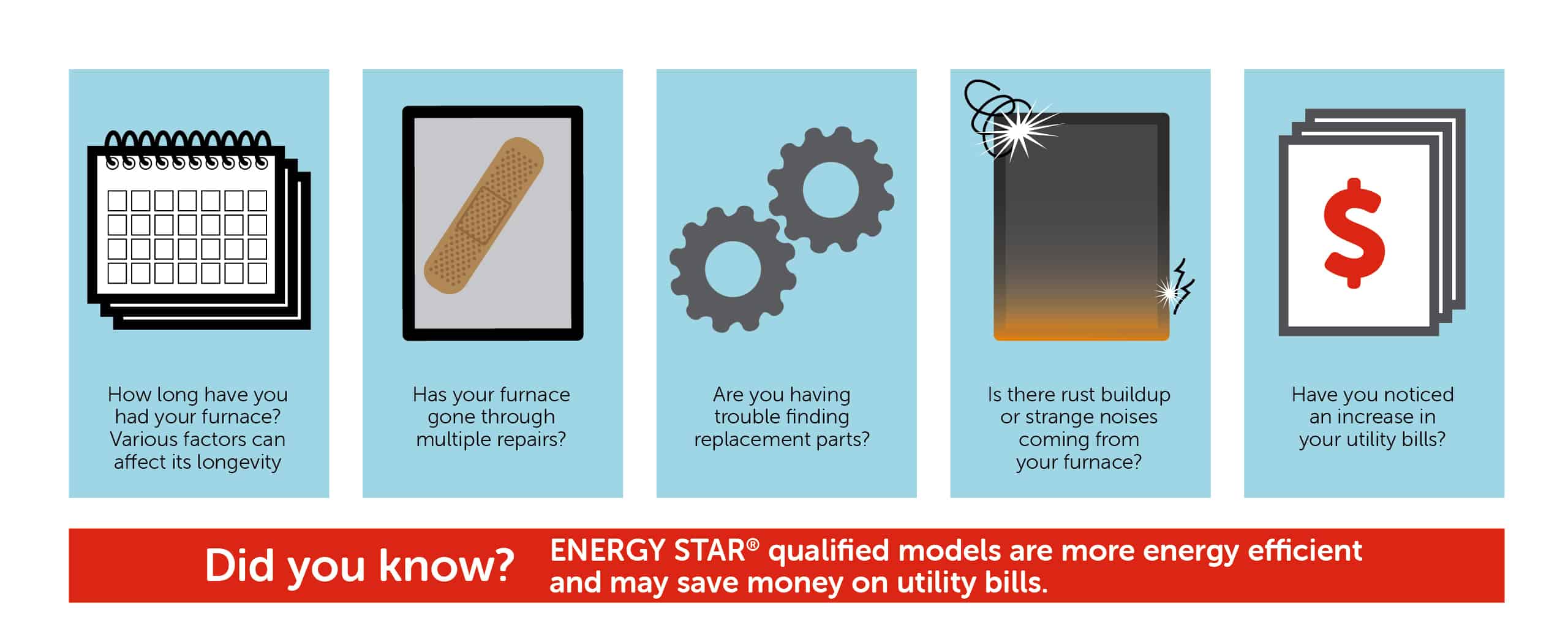
Consider the Furnace’s Age and Overall Condition
Month after month, year after year, we’re not the only ones showing the subtle signs of ageing. Furnaces do, too. It’s only natural. With Canada’s cold winter climate, a furnace continually needs to work hard to keep you and your family comfortable. But it’s not just winter that poses challenges for your furnace. For homes with central air conditioning, the furnace blower may also circulate cooled air through the ductwork during the summer. This means some furnace components operate during both the heating and cooling seasons.
Age can provide helpful context, but it should not be used by itself to decide whether a furnace must be replaced. Installation quality, previous maintenance, operating conditions and the condition of the major components can all affect how long a furnace remains reliable.
A licensed technician should assess visible corrosion, recurring condensate problems, or deterioration around the furnace. Rust alone does not confirm that the complete system must be replaced, but it can indicate an issue that requires investigation.
Review the Furnace’s Repair History
Have you needed any furnace repairs in the last two years? When a furnace is nearing the end of its life, it may break down and need repairs more frequently. If you’ve recently had one part of your furnace replaced only to discover that something else needs to be repaired, it could mean it’s time for a new unit.
*PRO TIP – Ask what caused the current problem, which component needs repair and whether the rest of the furnace is in good condition. A significant repair may still make sense if the furnace is otherwise reliable and replacement parts are readily available. Replacement may be more practical when a major repair is required, and the furnace also has other existing problems that the repair will not resolve.
If you aren’t quite ready for a new furnace, consider a protection plan for your system to protect yourself against unexpected and mounting repair costs. Reliance® offers Heating & Cooling Protection and Maintenance Plans that can cover most common repairs for your furnace and air conditioner. An annual maintenance plan to ensure everything is working at optimal performance is another good idea to help you save. Read our Protection Plan Buyer’s Guide to learn more.
Check Whether Replacement Parts Are Available
Replacement parts for some older furnace models can become difficult to source. Ask whether the required part is currently available, whether an appropriate replacement component can be used, and how parts availability may affect the repair.
Limited parts availability does not automatically require furnace replacement, but it can affect how practical the repair is and how quickly it can be completed.
Consider Comfort, Noise and Reliability
Unusual banging, rattling, squealing or popping sounds can indicate a mechanical or airflow problem that requires diagnosis. Uneven heating, weak airflow, frequent cycling or difficulty reaching the selected temperature can also show that the heating system is not operating as expected.
Some of these problems can be repaired. Others may be related to furnace sizing, ductwork, airflow or multiple equipment issues. A technician should identify the cause before replacement is recommended.
Consider a system tune-up from an expert you can trust – after all, your furnace is the heart of your home and requires attention as it starts to age.
Your Utility Bill is Unusually High
As utility rates rise, so could the potential cost savings from a newer, more efficient furnace.
Consider an energy audit that can help you understand where you’re losing heat in your home and what you can do to increase the overall energy efficiency of your home. Regular maintenance can also help ensure you’re getting the best performance possible out of your heating and cooling equipment.
What Should a Furnace Technician Check?
A licensed technician can inspect the furnace and explain whether the current problem can be repaired safely and reliably. The assessment should consider:
- The cause of the current furnace problem
- The condition of major furnace components
- The furnace’s previous repair history
- Whether the required replacement parts are available
- Whether the proposed repair is likely to restore reliable operation
- Whether there are safety concerns
- Whether the furnace is appropriate for the home’s heating requirements
Ask for a clear explanation of the repair option, replacement option and the costs associated with each before deciding.
Still Not Sure Whether to Repair or Replace?
Use the Reliance furnace repair-or-replace quiz to consider the age, condition and repair history of the furnace before discussing the next step with a licensed professional.
Take the furnace repair-or-replace quiz.
Furnace Repair or Replacement FAQs
How much does furnace repair cost?
The cost depends on the failed component and the work required. Reliance service data shows examples ranging from $579 for fan and limit controls to as much as $2,299 for a ventor motor assembly. A technician must diagnose the furnace before providing a repair estimate.
Is it cheaper to repair or replace a furnace?
Repairing a furnace usually costs less upfront than replacing it. However, the decision should also consider the furnace’s overall condition, previous repairs, parts availability and whether the proposed repair is likely to restore safe and reliable operation.
Is it worth repairing an older furnace?
An older furnace may still be worth repairing if the problem is limited, replacement parts are available and the furnace is otherwise in reliable condition. Replacement may be more practical when breakdowns are recurring, parts are difficult to find or the furnace has multiple existing problems.
Should I replace my furnace after an expensive repair estimate?
Not automatically. Ask the technician what failed, whether other major components are in good condition and how likely the repair is to restore reliable operation. Compare the repair estimate with the furnace’s overall condition and the cost of an appropriately selected replacement system.
How many furnace repairs are too many?
There is no universal number. Increasing repair frequency, repeated failures involving different components and repairs that do not restore reliable heating can indicate that replacement should be considered.
What should I do if my furnace will not turn on?
Start by checking that the thermostat is set to Heat and above the current room temperature. Confirm that the main furnace switch is on, the circuit breaker has not tripped, the filter is not visibly dirty and all normal furnace doors and filter panels are fully closed. If the furnace still will not start, call a licensed furnace professional.
If your furnace is not heating properly, arrange a professional furnace repair so the problem can be diagnosed before you decide whether to repair or replace the system.
For more information on all the different kinds of home heating options available to you, check out our Ultimate Furnace Guide.
If you have any questions about heating your home, Call on Reliance™ today to schedule time with one of our trusted Home Comfort Advisors. The advisor will assess your home and discuss your needs to find the right solution for you and your family.
Check out our latest Furnace offers here!
See Latest OffersRelated Articles