Skip to content
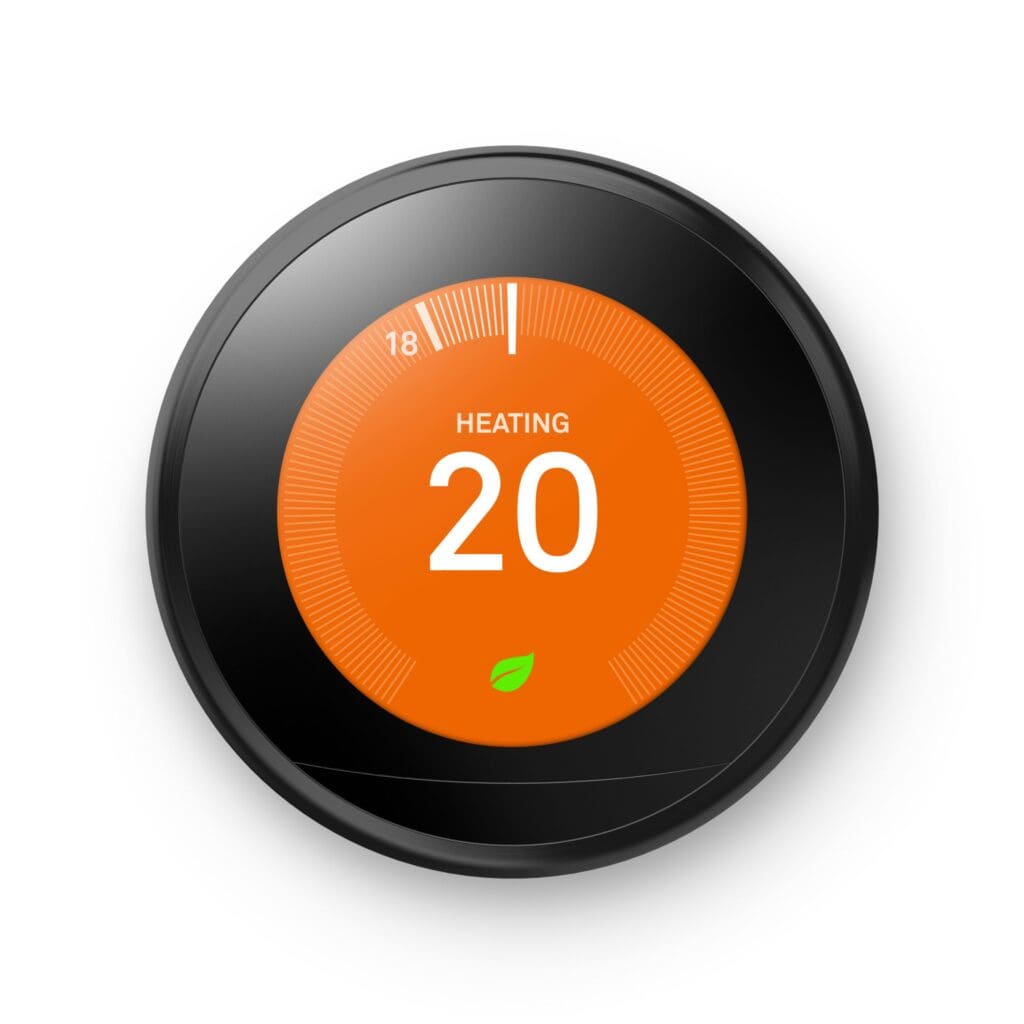
Black thermostat with organe user interface

How to Set Up Your 3rd Gen Google Nest Learning Thermostat

To set up a 3rd Gen Nest Learning Thermostat: power on the thermostat (or restore it to factory settings), then follow the on-screen prompts to (1) choose your language, (2) connect to Wi-Fi, (3) set your location, building type, thermostat location and heating and cooling system type, and (4) run a systems test. You control the Nest by rotating the outer ring to scroll and tapping the bottom of the screen to select. The full walkthrough is in the video below.

Video thumbnail
<iframe width="560" height="315" src="https://www.youtube.com/embed/i0x_j29SjsQ" title="YouTube video player" frameborder="0" allow="accelerometer; autoplay; clipboard-write; encrypted-media; gyroscope; picture-in-picture; web-share" allowfullscreen></iframe>
Hello! I’m Shane with Reliance.
While many customers typically book  in-home installation and setup with
an expert Reliance technician like me, we  realize that that’s not always possible. So,
I’m here to take you step by step through the  setup and operation of your new thermostat.
The new Google Nest 3rd Generation Learning  Thermostat is a connected thermostat.
It gets its name from the way it learns the living  patterns in your household, then automatically
optimizes your home’s heating and cooling, which  can improve the efficiency of your HVAC equipment.
Want to control the temperature in your home with  your phone? The Google Nest Learning Thermostat
can do that! Plus, you can monitor  your energy usage over time, and more.
Alright, let’s get started!
If your Nest is new or it’s just  been restored to factory settings,
the thermostat’s illuminated screen will  prompt you to input your setup information.
Alternatively, if your Nest has already been  set up, you can skip ahead in this video
where you will find steps to walk you through the  thermostat’s numerous features and functionality.
Let’s get you familiarized  with the Nest device itself.
This easy-to-use thermostat is  controlled using two different
motions that you make with your hands: By rotating the outer ring, you can
wake up the display, scroll through the Nest’s  various menu options, and increase or decrease
the desired temperature of your home. Alternatively, tap or click the bottom
of the screen—almost like you’re using an Enter  command on a computer—to access the main menu,
choose menu items, and select letters and numbers. Here’s a handy trick: You can toggle between
capital and lower-case letters by  double-tapping your chosen letter.
To begin the setup, rotate the Nest’s  outer ring to the Language option,
and choose either English or French  by tapping the bottom of the screen.
At this point, be sure to have your Wi-Fi  password handy, as the next step involves
connecting your Nest to the internet. Rotate  the outer dial to the Internet option, press,
and enter your details when prompted. Just  so you know, you don’t necessarily need an
active internet connection to operate your new  thermostat. However, we do recommend that you do
so, in order to take full advantage of the Nest’s  many smart features, including displaying local
weather conditions on the screen and controlling  the thermostat from your phone while you’re away.
Plus, when you connect your Nest to  Wi-Fi, it can download the latest
software updates automatically, which will  keep it running in tip-top shape over time.
If you’d like to make use of Nest’s remote-control  capabilities and other useful functionality,
now’s the time to download the free  Google Home app to your smartphone.
Ok, let’s continue with the setup.
Next on the menu, the system will ask for your  Location so it knows about the weather outside,
the type of building you’re in; single  family, multi-family, apt/condo or business,
where the thermostat is located in your home,
and a few things about what kind of  heating and cooling system you have.
Once complete, tap or click the bottom  of the display to go back to setup.
Finally, rotate the outer ring to choose the  Complete a Systems Test option. And with that,
you’ve completed the setup of your new Google  Nest 3rd Generation Learning Thermostat.
Now, let’s move on to the features  and functionality that make this
such a popular thermostat for  homeowners around the world.
Let’s look at the module itself:  You’ll see the current temperature
of your room displayed in a small number  along one side of the thermostat display,
while the target temperature—also  called the “setpoint” or “HEAT
SET TO temperature”—will be displayed in  large numbers in the centre of the screen.
If the HEAT SET TO temperature is above the
current room temperature and your  furnace or boiler is turned on,
then the screen will appear orange and it will  trigger the delivery of heat to your home.
Alternatively, if your air conditioner  is turned on and you rotate the Nest’s
outer ring counter-clockwise so that the  setpoint drops below the current temperature,
the illuminated screen will go blue to indicate
that it’s in cooling mode. On the other  hand, if you don’t have an air conditioner,
the screen background will remain dark when the  setpoint drops below the current temperature.
On this same display, a Nest  leaf icon will appear if you’ve
programmed the thermostat to alert you about  energy-saving performance of your system.
To navigate through the various settings, rotate  the outer ring, which will bring different menu
options to the top. Tap or click the bottom of  the display to enter the Main Menu, and you’ll see
Time, Date, Weather, Humidity and Temperature  Levels displayed in the centre with a checkmark
icon at the top of the screen and  other icons around the perimeter.
Rotate the outer ring to bring different menu  settings to the top and become clickable.
Navigate to the THERMOSTAT setting to select HEAT,
COOL, ECO or OFF settings, tapping or clicking  the bottom of the display for your preferred
selection. You can now return to the main  setting menu by tapping or clicking again.
Then, rotate to the clock icon to see your  household’s energy usage patterns over time.
Note that your thermostat’s Energy History  is a detailed summary that covers the last
10 days. You can view it in your thermostat or  with the Nest app on a phone, tablet, or computer.
Next, to access one of the Nest’s most  useful features, rotate the outer ring
to the SCHEDULE menu and tap or click the  bottom of the display to configure your Nest
for scheduled temperature settings at  any time of day throughout the week.
Scroll to a date and time using  the outer ring, tap to choose NEW,
tap again, then scroll up or down to determine  the desired temperature setting for that time.
Tap once more to choose that setting, then  scroll to other dates and times to set more.
With the next icon, the gear-shaped SETTING  option located at the top of the display,
tap and you’ll find LOCK or DO NOT LOCK options.
Choose the LOCK option to prevent other people in  your household from adjusting your Nest settings.
The next main item in the SETTINGS  menu—called ECO—allows your home’s
temperatures to rise or fall naturally within  a pre-set margin from your target temperature,
which can help to reduce your energy  consumption levels while you’re away from home.
To set your ECO TEMPERATURE  threshold, rotate the outer ring,
tap to select your preferred temperature  threshold, then tap or click DONE.
Next, rotate the outer ring  again to go to HOME/AWAY ASSIST,
which allows you to activate  or deactivate ECO mode.
Now, rotate the outer ring to the NEST  SENSE option, where you can access
several smart functions: When you activate AUTO-SCHEDULING,
your Nest will learn the manual temperature  settings you’ve used in the past and create an
automatic temperature schedule for your home. The TIME-TO-TEMPERATURE function provides
an estimate of the amount of time it  will take for a change in temperature
to be reached after you’ve dialled it in. Activate the SUNBLOCK feature to prevent your Nest
from being thrown off by sunshine hitting  it during certain times of the day.
Next, we move to the display’s  BRIGHTNESS control: Choose Low,
Medium, High or Auto by rotating the outer  ring until you’ve got your preferred setting,
then tap or click the bottom  of the display to select.
The DISPLAY setting comes next. This  is where you’re able to customize the
use and appearance of your Nest display. You can choose to activate or deactivate
the FARSIGHT option, which wakes up and displays  information on the main screen when anyone gets
close to or touches the thermostat. If you don’t  want the thermostat to wake up automatically,
simply deactivate this option. Rotate the outer ring more to choose
from TARGET TEMPERATURE, CURRENT TEMPERATURE,  ANALOG CLOCK or DIGITAL CLOCK options.
Next, adjust the WEATHER setting to  have information about local weather
conditions appear on the main screen.  But remember that you’ll need to have
set up your Wi-Fi connection to be able  to display weather on your Nest device.
Move to the next SETTING icon to turn your  Nest Thermostat’s CLICK sound ON or OFF.
Next, rotate the outer ring along the SETTING  menu to choose the format of the temperature
display—whether Fahrenheit or Celsius. As you  scroll further, you’ll see additional features,
including your heating and cooling system  details, factory RESET, and NEST PRO menu
item which is only accessible to professional  installers like our Reliance technicians,
as well as the TECHNICAL INFO item which  displays various features of your Nest system.
And with that, you’ve completed the setup  and orientation of your new Google Nest
3rd Generation Learning Thermostat!
Don’t forget, If you have any questions about  configuring or using your connected thermostat,
just Call on Reliance™.

Many customers book in-home installation and setup with an expert Reliance® technician, but we know that is not always possible. The video below walks you through setup and operation of your new Nest 3rd Gen Learning Thermostat step by step. It is a connected thermostat that learns your household’s living patterns and automatically optimises your home’s heating and cooling, which can improve the efficiency of your HVAC equipment. You can also control the temperature from your phone and monitor your energy use over time.

How the Nest is controlled

  • Rotate the outer ring to wake the display, scroll through menu options, and raise or lower your target temperature.
  • Tap or click the bottom of the screen (like pressing Enter) to open the main menu, choose menu items, and select letters and numbers.
  • Double-tap a letter to toggle between capital and lower-case letters when entering text such as your Wi-Fi password.

Step-by-step setup

  1. Start setup. When the Nest is new or freshly restored to factory settings, the screen prompts you to enter your setup information. If it is already set up, skip ahead to the features section.
  2. Choose your language. Rotate the outer ring to the Language option and tap the bottom of the screen to select English or French.
  3. Connect to Wi-Fi. Have your Wi-Fi password ready. Rotate the ring to the Internet option, press, and enter your details. Wi-Fi is not required to operate the thermostat, but it is recommended so you can use smart features such as local weather on the display, phone control while away, and automatic software updates.
  4. Download the Google Home app (optional). To use remote control and other connected features, download the free Google Home app to your smartphone.
  5. Set your location and system details. The Nest asks for your location (so it knows local weather), your building type (single family, multi-family, apartment or condo, or business), where the thermostat is located in your home, and details about your heating and cooling system. Tap the bottom of the display to return to setup when done.
  6. Run a systems test. Rotate the outer ring to the Complete a Systems Test option to confirm everything is working. That completes setup.

Key features at a glance

Feature What it does
Schedule Set target temperatures for specific days and times throughout the week.
Eco Lets temperatures drift within a preset margin from your target while you are away to help reduce energy use.
Auto-Schedule Learns your manual settings over time and builds an automatic temperature schedule.
Home/Away Assist Turns Eco mode on or off based on whether anyone is home.
True Radiant Anticipates how long a target temperature takes to reach and starts your system early so scheduled times are met.
Sunblock Prevents direct sunlight on the thermostat from throwing off temperature readings.
Energy History Shows your energy usage over the last 10 days on the thermostat or in the app.
Lock Prevents others in the household from changing your settings.

Screen colours give you a quick status check: the display turns orange when your furnace or boiler is delivering heat, and blue when your air conditioner is cooling. A Nest leaf icon appears when you are running at an energy-saving temperature.

Still have questions or want an in-home consultation? Just Call on Reliance™ and we will be happy to help.

Google and Nest Learning Thermostat are trademarks of Google LLC.

Video chapters

  • 0:00 Intro
  • 0:47 The basics
  • 1:38 Connect to Wi-Fi
  • 2:32 Location and systems test
  • 3:04 Heat Set To and Eco
  • 4:03 How to navigate
  • 4:56 How to schedule
  • 5:36 Eco mode
  • 6:05 Nest Sense options
  • 6:34 Brightness
  • 6:47 Display options
  • 7:27 Click sound on or off
  • 7:33 Celsius or Fahrenheit

Visit our Smart Home page to learn more about connecting the rest of your home.

Have questions about your smart home products? Visit our Smart Home FAQ’s page.

Visit our Furnace Resource and Air Conditioning Resource pages to learn more about your heating and cooling systems.

*Google and Nest Thermostat are trademarks of Google LLC

3rd Gen Nest Thermostat FAQs

Do I need Wi-Fi to use the Nest thermostat?

No. The Nest works as a thermostat without an internet connection, but Wi-Fi is recommended so you can use smart features such as phone control, local weather on the display, and automatic software updates.

How do I control the Nest thermostat?

Rotate the outer ring to wake the display, scroll through menus, and change the temperature. Tap the bottom of the screen to open the main menu and make selections.

What does the orange or blue screen on my Nest mean?

The screen turns orange when your furnace or boiler is actively heating your home and blue when your air conditioner is cooling. If you do not have air conditioning, the background stays dark when the set point drops below the current temperature.

What is Eco mode on the Nest thermostat?

Eco mode lets your home’s temperature rise or fall within a preset margin from your target while you are away, which can help reduce energy consumption. You can turn it on or off automatically using Home/Away Assist.

How do I set a schedule on the Nest thermostat?

Rotate the outer ring to the Schedule menu and tap the bottom of the display. Scroll to a day and time, choose New, then scroll to set your desired temperature. Repeat for other times and days.

Can Reliance install and set up my Nest thermostat?

Yes. Reliance Home Comfort® technicians are trained specifically on Nest installation and setup, can install and configure your thermostat for you. Call on Reliance to book an appointment.

Back to Learning Centre

Previous